Senior Product Manager 0→1 AI, payments & B2B SaaS · country P&L and team

Pryank Wadhera

I build products and the businesses around them.

Seven-plus years, five-plus in product, building 0-to-1 B2B SaaS, B2C and AI products across India and Africa. Today I'm Country Head and Product Manager for FuelBuddy in Zimbabwe, running the P&L while keeping release ownership of both platforms.

Current role
Country Head & PM, Harare (since May 2026)
Home base
New Delhi
Available
Immediately · relocation, hybrid or remote
Globe showing a route from New Delhi to Harare, the market I launched from zero and run, and fainter routes to Lusaka and Lagos, markets I evaluated for entry that are now the next rollouts. A separate marker in Dubai shows the UAE team I coordinate with.

What I've shipped inside a company

Results from FuelBuddy, largest scope first. Each started in the field, not in a document.

0 → 8active depots, in a country the business entered from zero

A new country, launched and run (Zimbabwe)

Market entry, P&L

Led the evaluation of Zimbabwe, Zambia and Nigeria, then launched B2B bulk fuel in Zimbabwe: ~15 suppliers signed in month one, including the national oil company on USD settlement, and 50+ enterprise and regional clients won from a 400+ network. Supplier volumes are allocated across the depots from a daily demand forecast, with zero stock-outs. Case study
<½ dayvendor activation, down from over a day

Vendor Management System

B2B platform, 0→1

Validation and compliance rules built from 300+ pump-owner interviews took activation to under half a day. The platform now serves 150+ vendors. Case study

2,000+UPI transactions in month one

UPI checkout, shipped inside the B2B platform

Payments, 0→1

Specified and shipped UPI Intent and QR checkout, piloted with FuelBuddy's own teams in Gurugram, Bengaluru, Hyderabad and Odisha, so failure handling and reconciliation were proven before customers relied on them. Case study

~₹4 lakha month in fuel saved by months 5–6 of a pilot at a major Indian steel producer

IoT loss-control platform for heavy industry (fuel)

IoT, industrial SaaS, 0→1

Defined 100+ requirements for one platform across tank gauges, dispensers, flow meters, RFID nozzle tags and tank sensors. Measured against the site's own baseline, the six-month pilot cut loss, theft and spillage by about 20 paise per litre, on roughly 2 million litres of diesel a month. Case study

A/B testedfixes against the live delivery baseline

Delivery-time optimisation, A/B tested

Operations, experimentation

Root-caused failures in IoT-server order sync, route optimisation and slot booking, tested the fixes against the live delivery baseline, and kept the ones that moved the average: delivery time came down from 60 to 55 minutes, and by up to 10 minutes on some trucks.

Commercial terms stay private. Figures are rounded. The LegalTech MVP and Agile process work from 2021–22 is in the career path.

Products I've built end to end

Built on my own time, each from a field problem I've seen first-hand: product docs first, then working code you can open.

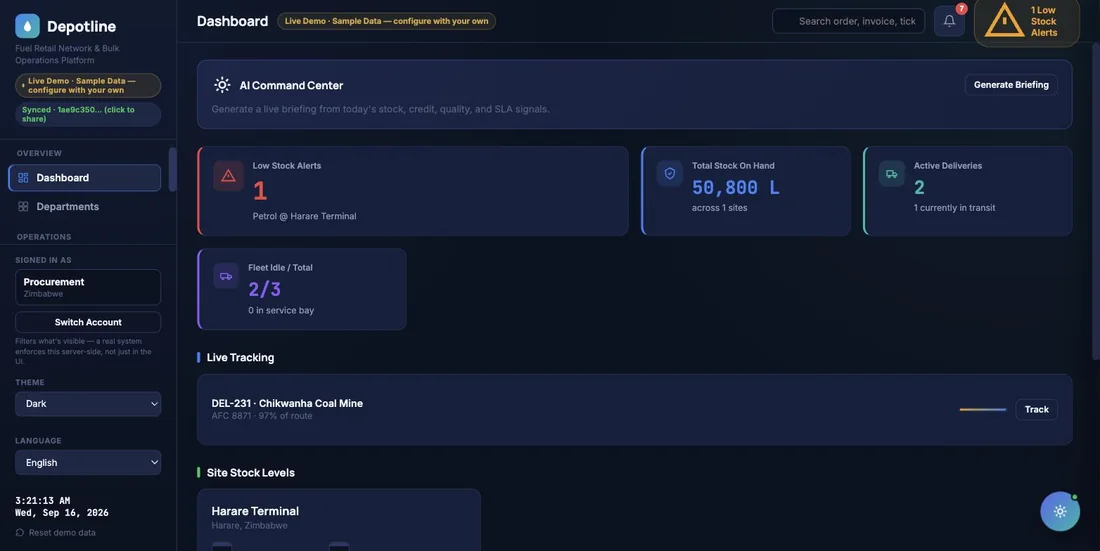
Depotline dashboard showing depots, deliveries and margin

5 in 1areas of depot work in one live view

Depotline

B2B operations SaaS (energy)

Depot operators juggle stock, pricing and fleet fuel logs in spreadsheets. One live view across depots, deliveries, fleet, inventory and finance, with margin always visible.

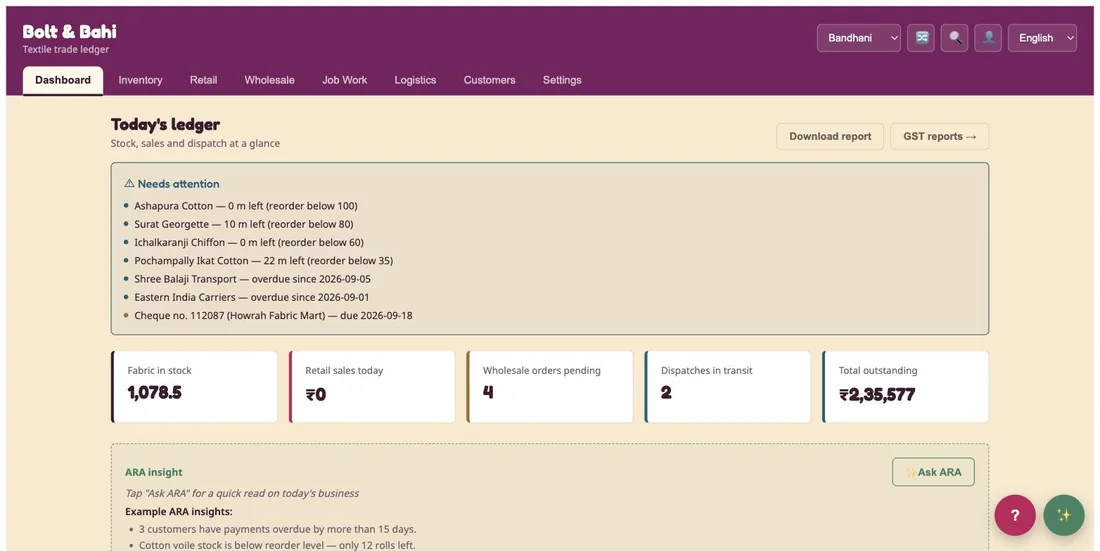
Bolt and Bahi ledger showing billing and receivables

10languages in one local-first GST ledger

Bolt & Bahi

B2B SMB, vertical SaaS, India

Indian textile traders run billing, stock, job work and receivables across notebooks and Excel. A local-first GST ledger with ARA, a built-in AI assistant, in ten languages.

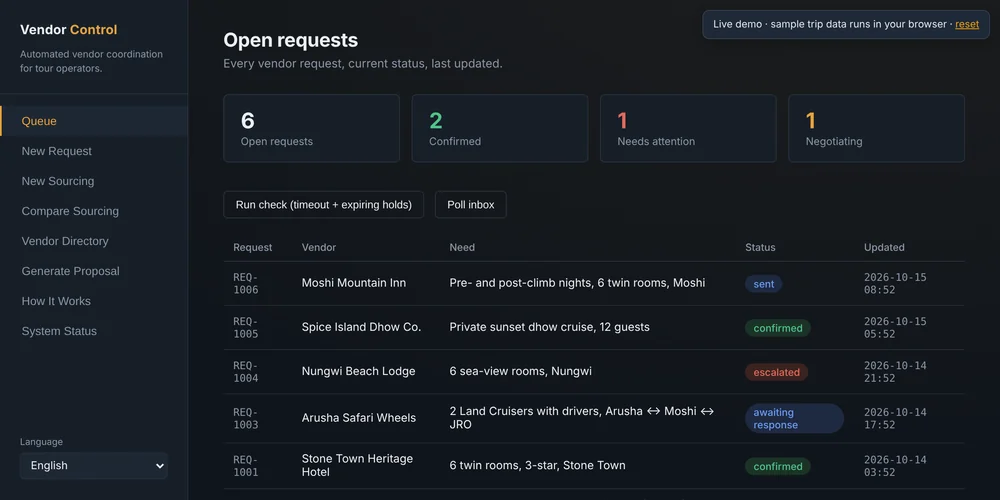
100%of 100 test trips completed, vs 86% for a rules baseline, with 0 price-limit breaches

Msafara

B2B, AI agents, travel

Tour operators chase hotels and vendors by hand. A multi-agent system where LLM agents read trip requests and vendor replies, then decide to accept, counter or escalate by calling tools, while code enforces the price limits and a person approves every message. Python, LangGraph, tool calling and RAG, measured on 100 synthetic trips against a rules baseline.

What the agent is allowed to do

  • Draft and send vendor requests, then follow up when a vendor goes quiet
  • Negotiate only inside price limits enforced in code: a tool refuses any counter outside them
  • Hand off to a person whenever a reply is unclear or a rule would be broken; nothing is sent without approval
Msafara vendor queue showing open, confirmed, negotiating and escalated requests

Three more, each built to test one product question

Range beyond my day-job domain: a two-sided EdTech trust problem, multi-tenant B2B credit control, and a consumer subscription offer.

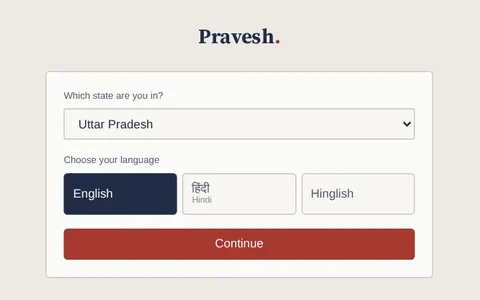
Pravesh

B2C EdTech, live

Can exam prep for UPSC, SSC and banking aspirants win a family's trust? Daily targets, mock-test log, guardian sharing and consent flows, in English, Hindi and Hinglish. Live, free, with voluntary UPI support.

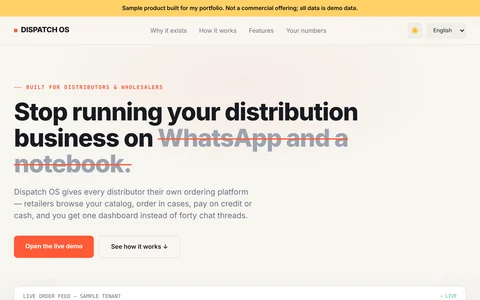
Dispatch OS

B2B distribution SaaS, multi-tenant

Can one queue replace the phone for an FMCG distributor? Per-tenant ordering, credit control, stock and SKU catalogue. The MVP is used in distributor pitches.

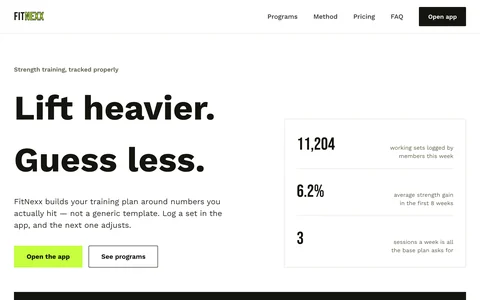
FitNexx

B2C subscription

Will people pay for training that adapts set by set? Every logged set adjusts the next one, with pricing pages built to test the offer.

Personal builds, separate from employer work. Pravesh is live; the other demos run on sample data.

Case studies

Written the way I run product reviews: problem, evidence, decision, result, and what I'd do differently. Commercial terms stay private.

Running

Opening a new country for the business, from zero

Choosing a market, launching B2B bulk fuel in Zimbabwe, and finding what the product has to be before it has to be software.

Problem

The company wanted to expand into Africa, with no local presence, suppliers, banking or customers in any of the candidate countries.

Evidence

Evaluated Zimbabwe, Zambia and Nigeria for the CEO, then picked Zimbabwe. On the ground, 40+ discovery interviews with transporters, vendors, fuel stations and corporates shaped what to sell first and what the product would need later.

Decision

The business before the product: banking, procurement, credit, dispatch and reporting under written SOPs, with ~15 suppliers signed in month one, including global commodity traders and the national oil company on USD settlement. The interviews became FMS and VMS requirements fed through a live feedback loop.

Result

A live B2B business with 8 active depots and 50+ enterprise and regional clients won from a 400+ network, zero stock-outs against a daily demand forecast, and the Country Head role added to the product one.

What I'd do differently

I scoped an on-site fuel management system for a large enterprise client, hardware and digital payments included, before confirming the hardware could be sourced in-country. It's paused. In a new market, check the supply chain for the product before you check the appetite for it.

Shipped

Vendor onboarding in under half a day

A B2B vendor platform for petrol-pump owners at a fuel-delivery startup in India, built from what the pump owners showed us.

Problem

Bringing a pump on as a vendor took a full working day of document collection and checks, then a second review the next day, so no new vendor could take orders the day they signed up.

Field evidence

300+ conversations with petrol-pump owners, at their pumps rather than over a survey. They showed which checks repeated for every vendor and could be standardised.

What I built

Standard validation and compliance rules inside the onboarding flow, so a submission was checked once, against one rulebook, at the moment of entry instead of the next morning.

Result

Activation came down from over a day to under half a day, and the platform now serves 150+ vendors.

What I'd keep

The fix was a rule set more than a feature, and it came from the pumps, not from a document. Every platform I've built since started the same way.

Shipped

UPI checkout, specified and shipped in the B2B platform

UPI Intent and QR checkout for the B2B platform, piloted internally with FuelBuddy's own teams before wider use.

Problem

The B2B platform needed digital payments. The riskiest component was the checkout itself: UPI Intent and QR flows, failure handling and reconciliation against orders. Shipping it untested would have meant finding the failure cases in front of customers.

Evidence

The B2B platform already had daily users inside the company who paid for fuel on it. Every unknown in the checkout spec could be tested with them at no acquisition cost: intent hand-offs, failed-payment states and reconciliation against orders.

Decision

Specify the checkout for the B2B platform and pilot it internally first, with FuelBuddy's own teams in Gurugram, Bengaluru, Hyderabad and smaller clusters in Odisha, so the payment stack was proven before wider rollout.

Result

2,000+ UPI transactions in month one of the internal pilot, and the failure and reconciliation paths got real traffic before any customer relied on them.

Alongside it

Partnered with the GM and CEO on Project Arjun, an EV and oil & gas retail infrastructure plan built on 100+ fleet and EV operator interviews; plan approved by leadership.

Shipped

An IoT loss-control system for heavy industry, piloted at a major steel producer

Tank gauges, dispensers, flow meters and RFID on one platform, piloted at a major Indian steel producer.

Problem

At an industrial site, diesel leaves the tank through loss, theft and spillage that nobody can see, so nobody can price it. The plant knew its monthly consumption; it did not know how much of it was waste.

Evidence

Site walks at the plant, with the people who dispense fuel as well as the people who buy it. The gaps were at the nozzle and the tank, so the product had to live there: automatic tank gauges, dispensers, flow meters, RFID nozzle tags and tank sensors, 100+ requirements in all.

Decision

A six-month pilot measured against the site's own baseline, with the saving as the metric. The buyer could verify the saving at the meter, which is what makes a hardware-linked product sellable.

Result

Savings did not arrive in month one. As the controls and site behaviour settled, the six-month pilot cut loss, theft and spillage by about 20 paise per litre against the site's own baseline, a run-rate of ~₹4 lakh a month by months 5–6 on roughly 2 million litres of diesel a month.

What I'd do differently

Set the expectation of a ramp in the contract. A saving that climbs over six months reads as a miss in month two unless the buyer was shown the curve first.

Product documents

PRDs and BRDs written to the same standard, from industrial, fleet and fintech problems.

All documents on Notion

Earlier work, rewritten to the same standard: LegalTech compliance hub PRD and InvoiceDiscount for SMEs.

How I lead product

Today I run a country P&L and an eight-person team. Before that I was one of four PMs working with the CEO, CTO and MD and a 15-engineer team.

The problems I'm hired for

Payments and checkout
UPI Intent and QR, failure handling, refunds, reconciliation
IoT and hardware-linked SaaS
Tank gauges, RFID, flow meters, field-grade connectivity
B2B platforms
Vendor onboarding, credit, ordering, APIs and integrations
Market entry and P&L
Pricing, procurement, credit risk, regulators, hiring
Agentic AI
Multi-agent workflows with bounded autonomy and human escalation
B2C and consumer apps
Consumer checkout, onboarding funnels, subscription and EdTech apps
Technical product management
PRDs and API specs with engineering, SQL and product analytics, A/B testing, Agile delivery in Jira

How I work

  • Go to the site before writing the spec.The best products I've shipped started with a walk around a depot, not a survey form.
  • Price on value you can prove.If the buyer can verify the saving, they'll share it.
  • Say what we won't build.A scope is only as good as its non-goals list.

Research, then product, then the whole business

Each move added a layer: understanding users, building for them, then owning the economics around the product.

  1. May 2026 – present

    Country Head & Product Manager at FuelBuddy, Harare, Zimbabwe

    Asked by the CEO to run the Zimbabwe business alongside the product role; reports to the Business Head in India. Sets local release priorities for the fuel management and vendor platforms, writes the requirements taking both into Zambia and Nigeria, owns the P&L, including customer credit and collections, and leads an eight-person team. Coordinates with teams across the UAE, India, Zambia and Mozambique.

  2. Apr 2025 – Apr 2026

    Product Manager at FuelBuddy, Harare, Zimbabwe

    Moved to Harare for market entry, business development and FMS product fit: 40+ discovery interviews fed the backlog while I launched B2B bulk fuel from zero, with banking, procurement, credit and dispatch under written SOPs, and improved unit margins through pricing and supplier mix.

  3. Jan 2023 – Apr 2025

    Product Manager at FuelBuddy, Gurugram, India

    One of four PMs working with the CEO, CTO and MD and a 15-engineer team. EV-charging and fuel-retail research (Project Arjun), then the vendor platform, IoT FMS, UPI checkout and delivery speed; also secured the company's first Indian Oil (IOCL) retail station lease and led the Africa market evaluation.

  4. Sep 2021 – Dec 2022

    Associate Product Manager at Legal Suvidha (LegalTech B2B SaaS)

    Web and mobile MVP from Figma wireframes to launch within 8 months, the company's first Agile product process (time-to-market down 25%), and A/B-tested onboarding flows while website visitors grew from about 120 to 1,000+.

  5. Aug 2019 – Aug 2021

    Research Associate at Citizens’ Foundation for Policy Solutions, New Delhi

    Pollution-control policy research for the Delhi Government.

Why a historian ends up building products

Archaeology is fieldwork: you learn to trust what people do over what they say. That habit is why my products start at the depot, the pump and the plant, not in a survey form.

Education and beyond the day job

  • MBA, Artificial Intelligence for Business, O.P. Jindal Global University (Expected Dec 2026)
  • Master's, AIHC & Archaeology, Deccan College PG & Research Institute, Pune (2019); BA (Hons), History, University of Delhi (2017)
  • Certified Product Manager (micro1), Technical Product Management (Project Management Institute, via LinkedIn Learning), Agile Scrum Master (Simplilearn), Becoming an AI-First Product Leader (LinkedIn Learning), Professional Diploma in International Business Management (European Open University)
  • Guest mentor at IIM Raipur (PGP 2023–25), mentored student groups on international energy-business expansion and fuel management systems
  • Speaks English, Hindi, Punjabi and Marathi

Hiring? Check the fit in a minute.

Four questions about the role. For each answer you get the matching evidence from my work, marked as direct or adjacent, linked to where you can see it, and a summary you can send to the hiring manager.

No sign-up and no contact details asked. Your answers are not saved, and the summary only leaves this page if you choose to send or copy it.

What are you hiring for?

The fit check needs JavaScript. Download the resume instead.

Let's talk

Open to Senior PM, Lead PM and Product Lead roles. Home base New Delhi, open to relocation, hybrid and remote, and available to join immediately.

Prefer I reach you? Leave your number

Phone, email or both. One is enough.

Used only to get back to you. Never shared.

Question 1 of 4

Chat